by Beth | Aug 20, 2012 | Employee Hiring, Selecting Good Candidates
Most people who viewed the Olympics experienced some surprises regarding performances from our athletes. If you actually listened to the athletes talk about their goals, you may have had much fewer surprises.
Danell Leyva: “I want to win a medal.” So, he did. Bronze
John Orazco: “I just want to go to the Olympics.” So he did. He was a Top 10 finisher.
Gabby Douglas: “I want to make history.” So she did. She is the first African American Woman to win a gold medal in Gymnastics. She won 2.
In interviewing candidates, you can predict the success of your new hire by listening to their language around their goals in an interview. Writing down exactly what your candidate has to say can prevent performance surprises later down the road and lead your team to gold rated success!
by Beth | Jul 25, 2012 | Employee Hiring, Interview Process, Selecting Good Candidates
While rocking my infant daughter years ago, I began instinctively doing what adults have done for centuries. I began singing lullabies to her.
“Rock a- bye baby, in the tree top, 
When the wind blows the cradle will rock,
When the bough breaks, the cradle will fall
And down will come baby…”
And then I stopped.
I suddenly really listened to the words that I was about to sing! I thought to myself, “What kind of fool puts an infant in a cradle at the top of a tree and watches them fall?!” Horrified, I changed the words…
“…Right into Mama’s arms.'”
Ah…much better. My daughter was raised singing Rock-A-Bye Baby with a much better alternate ending. To this day, I am not sure that she even knows the original words to that song, which suits me just fine.
In the interview process, I teach people that the best skill to have is listening for word choice. I train them to stop, really listen to the words used by the candidate, and digest their meanings as they relate to the position for which we are hiring.
When you listen to the word choices of your candidate, they will tell you what you need to hear in order to make a great hiring decision. Word choices will expose blamers, know-it-alls, pass the buckers, and more.
When the interview is through, if you feel the candidate did not give you enough information, review your notes. The words you really need to listen for are in there. As an interviewer, your primary job is to pay attention to the word choices used by your potential employees. And be careful to not just hear what you want to hear. It truly means the difference between a decent employee and an A-list player. If any “boughs break” in your business, which would you rather have waiting at the bottom of the tree?
by Beth | May 9, 2012 | Employee Hiring, Interview Process, Selecting Good Candidates
 Last weekend, my 11 year old daughter Katy flew on an airplane BY HERSELF for the very first time. I was a nervous wreck! I had a hard time focusing on work…. I kept checking my phone to see if I had messages from her saying that she had landed safely. Katy, of course, was fine. In fact, she had a great time during her first solo flight and learned a valuable lesson in independence. I realized the more she can do for herself, the better equipped she will be in the future when dealing with unexpected situations.
Now you may ask what any of this has to do with interviewing. As I impatiently waited for the phone to ring, I had a realization that I need to provide my clients with the same level of independence. While I certainly adore helping each of my clients interview for their next great employee, I also realize that I need to get them better prepared to do interviewing all by themselves. Again, the more prepared they are in their businesses, the easier it is to handle unexpected personnel issues.
In the past, my typical process was to create and submit job ads, help develop job descriptions, vet interview candidates, schedule interview times, and then perform the actual interviews in front of my client. We would then do a “dash board” review in between interviews to uncover what we learned from each candidate, based on speech patterns, phrasing, and responses to my A-list candidate questions. Rarely, did I actually hand the interview process over to my client. They have certainly learned from the experience as 91% of the time, they retained the ideal employee they were seeking. But I realize that my mission with A-list Interviews is to transform the world through the interview process to create happy, healthy work environments for all. This cannot be achieved until I give my clients the gift of independence by empowering them to run effective interviews long after I am gone.
From now on, I will be including a hand over process where I will be teaching my clients how to interview by themselves through the program I have developed called “7 Steps to Amazing Employees”. I have seen this program work successfully in all walks of business so I am excited to help my clients develop their own comfort levels around the actual interview process. Now when they fly solo, I will still be a nervous wreck because I really want my clients to succeed, but I will know that I set them up for success and the world will be transformed through the interview process by hundreds of interviewers, not just me. And there is no better feeling than that!
by admin | Mar 28, 2012 | Interview Techniques
 With sweaty palms and a dry cotton mouth, Jane Smith opened the door and walked in. She approached the greeter and requested to meet with a certain person. She checked her hair and makeup in her hand mirror and then tried desperately to calm her nervous stomach. When she looked up, she saw the person that she was meeting, and she took a deep breath. “Here we go,” she thought. Is this a date or a job interview?
On the outside, the excitement of the first meeting, nerves and newness of it all give the interaction of an interview compared to a date an appearance of being the same. Candidates are in a vulnerable state when they walk into a job interview and going on a first date can produce similar feelings of vulnerability. But are they the same?
The largest difference between a date and a job interview is the power of the interviewer over the candidate. The interviewer decides when the interview will take place, its location, time of day, the agenda, whether there will be a second interview, whether the candidate gets the position and whether the candidate receives a “no thank you” for not retaining the position. All of the power sits with the employer. In dating, the 2 people come to the table as equals.
This power difference is why employers struggle with interviewing. They are often as uncomfortable with the power differentiation as the candidate, unsure of how to get around an environment that brings about one individuals desire to please and the others role to choose. Their sole desire is to make a good assessment for their next hire, yet candidates are just telling them what they want to hear. And of course they are! They are trying to find a job and willing to bear sweaty palms!
by admin | Mar 21, 2012 | Employee Hiring
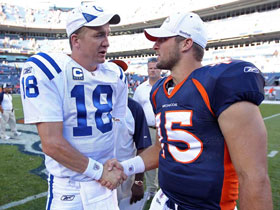
Peyton Manning is in and Tim Tebow is out.
First, when making a good hiring decision, a boss must ask this question: Can I work with this person? Both Tebow and Manning have solid reputations for being workable, and in this era of cranky celebrities, this is point for both of them.Was this a good hiring decision? Only time will tell.
Second, the next question is can they do the job? While Tebow has been somewhat inconsistent last year, so has Peyton Manning. While Manning has experience on his side, he is also injured and set in his ways. What happens if he gets injured again?
Third, is the candidate passionate about the job? Manning is a little crusty around the edges. He is older and he was a leader in the lockout with the NFL. Tebow loves the game of football. He is energetic, passionate and needs some coaching.
My vote? Hire Manning to train Tebow. Now you have experience coupled with passion and healthiness. That is a winning combination.